Architects of Our Own Worlds
Here’s a powerful statement: We create our reality.
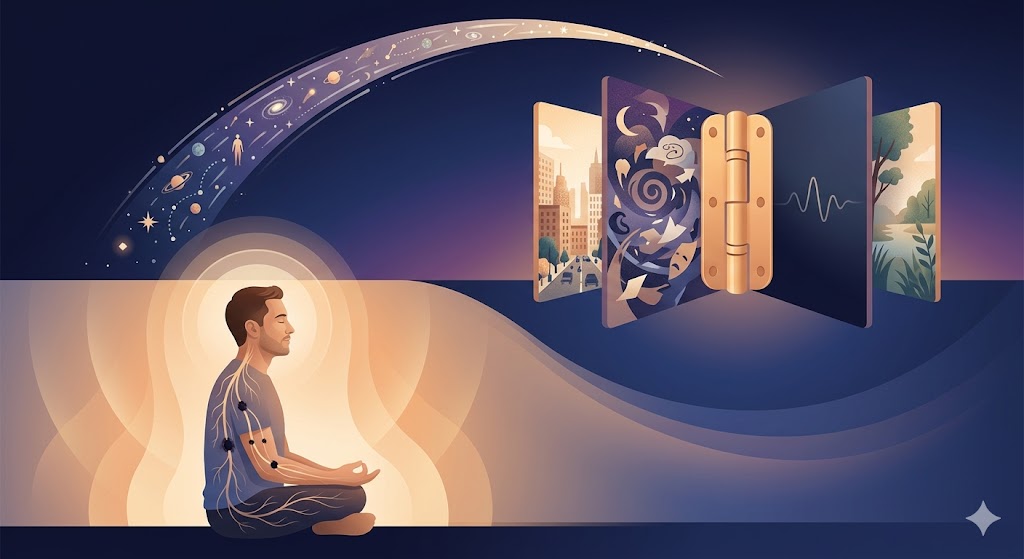
It’s a lesson that has demonstrated its validity to me time and time again, and in a number of contexts. In this Physiology is Consciousness integrative essay, I’ll be reflecting on how we create our own reality through our perspectives (paradigms), through our cortical development (as it is shaped by our experiences), and how proper rest is instrumental in creating a reality that is conducive to the full maximization of our potential.
But what does it mean, pray tell, to create our reality?
On one hand, reality seems to already be created without any input needed from us. This world of relative form seems like a realm of pre-established rules and hardwired natural tendencies, begotten by mechanisms and laws that predate the existence of humans. As people, we don’t create the world of form, but we live in it, interact with it, and add to it.
On the other hand, there are about 8.3 billion human beings inhabiting the relative world, and you will never find two people who experience reality in an identical way. Truly, sometimes, our individual realities seem entire worlds apart.
As a random example, some people default to looking for the best in their fellow humans, while others constantly expect disappointment, betrayal, and division. This is no small distinction, for we surely have the capacity to find evidence for whatever it is that we believe to be true; at which point that evidence just makes it seem even truer. Meanwhile, someone else believes and finds their own evidence for the exact opposite (isn’t this reality-creating business fun?).
In so many ways, the world is as we are. We don’t, as individuals, decide the laws of the universe; but we do possess the ability to improve the quality of our attitudes, beliefs, and choices, thereby creating an empowering and stable subjective experience of reality.
Power of Paradigms
So, just what is it that determines how we see and relate to reality? Simply put: Our paradigms.
In lesson 1.1 from our coursework, paradigms are defined as, “the framework to judge individual goals and actions in relation to the larger world view,” and are described as being molded by our experiences, impacting all of our thinking and choices without us being aware of it (Travis, 2024). In other words, we’re so up-close to our own paradigms about ourselves and the way the world is or should be, that it can be hard to think beyond the limitations of our worldview—even in cases where doing so could lead to higher levels of functionality and fulfillment.
To change a paradigm is to re-write our rules of engagement with life, creating new dimensions of possibility and effectiveness in the place of former limitations and debilitating setbacks. To illustrate this, permit me to disclose the most impactful paradigm shift I’ve experienced in my life so far: the moment when I exited a decades-long spiral of addiction and surrendered to recovery.
For years, I’d defended my reliance on substances as a personal choice that didn’t hurt anyone else. In fact, I ardently believed I was using drugs to make the world a better place. Because of this, I essentially martyred myself, misconstruing my loved ones’ frequent rejection of my lifestyle as ignorance, misunderstanding, and unwarranted judgment.
That paradigm sure did lead me to a lot of suffering and self-victimization. I became so unstable and unpredictable from my drug use that literally no sane person wanted to associate with me anymore. Interestingly, I couldn’t even yet see the relationship between my instability and the drugs. Through my lens back then, my instability came from the loneliness of feeling constantly misunderstood and rejected; in other words, my erratic spiral was everyone’s fault but my own.
At my lowest point, that reality I’d created was unbearable. To turn it around, I had to start acknowledging that my own paradigm was what brought me there, and that my own actions had pushed others away and crystallized my loneliness. I finally saw that my hell had been built brick-by-brick out of my own thinking and my own choices. If I wanted to be free, I needed new thoughts and new choices.
It was a paradigm shift that cannot ever be unlearned: the shift from blaming others to accepting responsibility. Imbued by these lessons, I built a new reality for myself with a foundation of stability, recovery, and growth—a path that would ultimately lead me to our beloved MIU and perhaps the most fruitful life hack of all time: Transcendental Meditation.
Experience Changes the Brain
So, if paradigms are our way of making sense of and engaging with the world, then where do our paradigms even come from? Well, in a sense, they come from our experiences (and the ways we interpret and process life, cultural norms, and inherited beliefs).
From our very first breath until our final gasp, every experience physically changes the brain. The brain’s natural ability to adapt in accordance with our experience is called neuroplasticity; and the mechanisms behind it are utterly fascinating. Let’s revisit lesson 2 to dig into this some more.
During week two of class, we learned about our grey matter processing centers and white matter myelinated axons (rapid information distributors), and how these aspects of our brains dynamically synergize to help us adapt to whatever circumstances life may present us (Travis, 2024). As our development commences at infancy and advances throughout childhood and onward, our brains make a noble play at optimizing our ability to adapt to our environment through a process called “pruning”—this just means that underutilized neural connections are deactivated so that cortical resources can be allocated to the pathways we use the most (Travis, 2022).
This is crucial to understand, especially as someone in recovery: the stronger a neural connection gets, the easier it gets to keep automatically engaging with the associated behaviors. This is the neurological basis of all habits. Our habits create our reality in so many ways, because they are essentially the parameters which limit or empower our behavioral and cognitive capabilities in this world. Through sheer repetition, our realities are often molded by habituated momentum rather than from conscious decision.
My former tango with addiction was solidified by decades of engaging with maladaptive behaviors and beliefs. My brain behaved exactly as it was designed: it stabilized the associated pathways, turning my unstable reality into my physical baseline. I had—completely obliviously, mind you—sculpted a brain optimized for self-destruction.
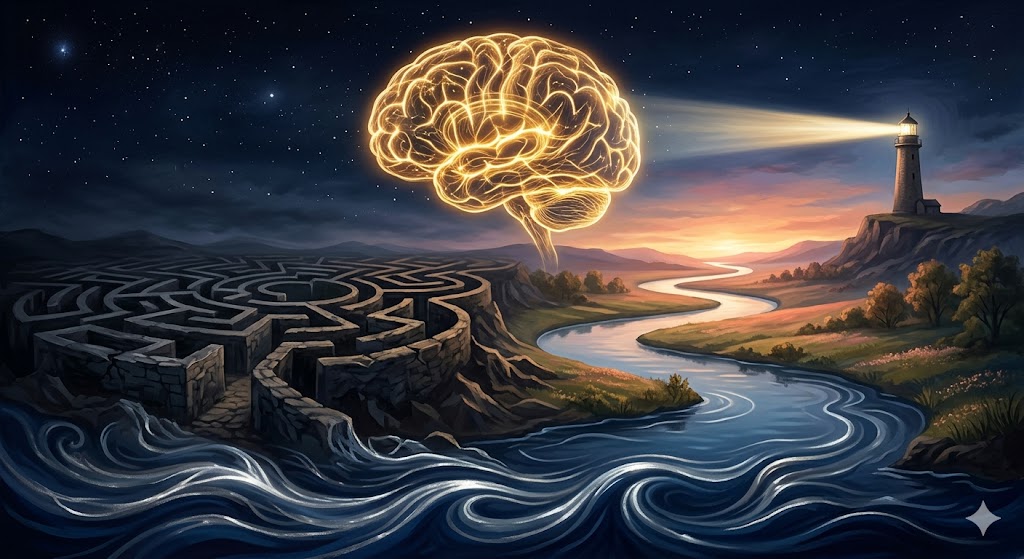
Being aware of these facts is a real game-changer. When we enter the sandbox of knowing that every experience changes the brain, we are authorized to choose experiences that strengthen neural connections that are supportive of health, well-being, and alignment with natural law. In the book The Brain is a River, Not a Rock (2022), Dr. Travis’ suggestion that doctors may one day prescribe experiences rather than drugs is one of the most refreshing takes imaginable. We could then—with complete consciousness and intentionality—sculpt our brains (and henceforth our realities) into lighthouses of peace, stability, and self-empowerment.
Sleep is Non-negotiable
To fully go all-in on creating the best reality possible for ourselves, the importance of proper sleep cannot be overstated. The non-negotiability of sleep becomes crystal clear through the lens of Maharishi’s Science of Creative Intelligence. Since I’ve quite extensively explored the “rest and activity are the steps of progress” SCI principle in previous assignments, here I’d like to focus on another gem: “knowledge is structured in consciousness.”
My understanding of “knowledge is structured in consciousness” is that our ability to perceive, know, and do things clearly depends on the quality of our current state of consciousness. But then, what does the quality of our consciousness depend on?
Back in STC 108, we learned that our current state of consciousness is largely related to the current state of our physiology. Our physiology, of course, is impacted by several lifestyle factors like diet, exercise, meditation, and most relevant of all for this discussion: sleep.
As week three in Physiology is Consciousness illuminated for us, sleep tangibly purifies and enhances our physiology, flushing away accumulations of metabolic waste and restocking our adenosine stores (Travis, 2024). This keeps our neural environment lean, clean, and well-equipped for life.
Furthermore, in sleep and through dreams, our brains process our experiences, strengthening important neural pathways and filtering out irrelevant connections (Hairston & Knight, 2004; Travis, 2024). This process is integral to mental efficiency and physiological purity, making deep sleep a heroic launching point for expanded clarity of consciousness and unrestricted access to higher levels of perception, knowledge, and action.
The Integrated Self
If we can agree that the quality of the reality we create depends upon our clarity of consciousness, then it seems like a given that our daily lifestyle choices are nothing short of sacred acts of creation. It’s a profound relief to know that we are never permanently imprisoned by our past choices and outmoded paradigms, and that we can perpetually reconstitute ourselves toward our truest potential.
As we all know by now, what we apply our focus on grows in our awareness. So, let’s use our focus constructively. For when we consciously align our habits and lifestyle with natural law, we line ourselves up to become reality-creating maestros, infused by restful alertness and innate intelligence, even supported in higher states of consciousness by the hand of Nature herself.
My MIU journey has reaffirmed for me that reality is not a static rock we are forced to climb; it is a dynamic river shaped by the quality of our awareness. By owning responsibility for our paradigms, our physiology, and our rest, our era of being passive onlookers reacting to a frantic world is over and it’s not ever coming back—now we stand tall as the conscious authors of our own provocatively heartful and breathtakingly beautiful realities.
References
Hairston, I. S., & Knight, R. T. (2004). Sleep on it. Nature, 430(6995), 27–28. https://doi.org/10.1038/430027a
Travis, F. (2024). Lecture 1.1: Paradigms [PowerPoint slides]. Canvas@MIU. https://miuonline.instructure.com/courses/3101
Travis, F. (2024). Lecture 2.1: The Evolving Brain [PowerPoint slides]. Canvas@MIU. https://miuonline.instructure.com/courses/3101
Travis, F. (2024). Lecture 3.1: Sleep [PowerPoint slides]. Canvas@MIU. https://miuonline.instructure.com/courses/3101
Travis, F. T. (2022). Your brain is a river, not a rock (3rd ed.). CreateSpace Independent Publishing Platform. (Original work published 2012.)