Greetings, beautiful person. My name is Andrew L. Hicks, and I’m honored by this opportunity to share with you what I’ve learned about higher states of consciousness from Maharishi International University. MIU was founded in 1971 by the most eccentric of visionaries—a man known as Maharishi Mahesh Yogi, who gifted Transcendental Meditation to the modern world.
For decades, I’ve engaged with different meditation practices to cultivate mindfulness, concentration, compassion, forgiveness, equanimity, stuff like that. TM is a completely different type of experience.
Maharishi once compared the other great meditation traditions to using a knife to cut vegetables or engage in other kitchen-related tasks, whereas TM sharpens the knife, which enhances its effectiveness in all aspects. What this really means at its core, is that TM is a technology which can expand our everyday consciousness into higher states—transcendent states, if you will.
Today we’ll be discussing the fourth and fifth higher states of consciousness, respectively known as Transcendental Consciousness and Cosmic Consciousness.
But first, let’s get on the same page about the first three states that we can all relate to: waking, dreaming, and sleeping. All three have their own unique physiological markers such as brain wave patterns and blood flow, and they all produce completely distinct subjective experiences. In waking consciousness—which you are currently experiencing, one would assume—we have awareness about ourselves and objects in the environment. When we dream, we have no (or very fragile) self-awareness, but remain capable of observing objects (psychic content) in the shifting dreamscape. Whereas in sleep consciousness, it’s lights out: no self-awareness and no object-awareness.
OK. Curveball: I want you to imagine for a moment that all things in our physical world of time, space, and motion—all the different objects and people; you, me, and all the rest—are generated by a timeless, spaceless, field of silent awareness, stillness, and infinite possibility. What we’re envisioning here is an absolute, changeless field of unmanifest creative potential that gives rise to the manifested world of relative form where we wake and sleep and dream and everything else.
Sound a little wild? Of course it is. Life is a little wild (just in case you hadn’t noticed).
But really, it’s not even as out there as it seems. These ideas come from some of the most coherent and all-encompassing frameworks humans have yet devised to explain reality—namely String Theory and Unified Field Theory (I suggest catching a talk by world-renowned quantum physicist John Hagelin if you really wanna fall in love with this stuff).
Anyway, this all sets the stage for our fourth state of consciousness called Transcendental Consciousness (from now on I’ll call it TC), or turiya chetana.
TC can be reached effortlessly through TM, which quiets the mind to finer and finer levels of awareness until something very special happens: We transcend thought altogether, as we settle into the source of thought itself; this is theoretically the same field of pure silence, awareness, and potential that manifests reality. In this expanded, blissful state of consciousness—this state of restful alertness, or Self with a capital S—the mind transcends time, space, and body sense; the only thing left to experience is pure awareness, and the only thing for the awareness to be aware of is itself.
TC is an easily experienced and well-researched phenomenon. Dr. Frederick Travis—kind of a big deal at MIU, really—suggests that there are three criteria for verifying the existence of higher states of consciousness:
First, there should be an expanded sense of self. Check.
Secondly, the subject/object relationship should be fundamentally different from other states. What we mean is that in TC, the subject and object are represented by pure awareness (subject) being aware of itself (object); which is different than the subject/object relationship in other states such as waking, where our attention (subject) is attuned to mental and environmental phenomena (object). So, again: check.
Thirdly, there must be physiological markers (like brain wave patterns detected by EEG) that are verifiably different from the other states. TC’s high degree of frontal alpha 1 power and coherence (the physiological signature of restful alertness) fulfills this third criteria, solidifying its status as its own distinct state of consciousness.
TM is a reliable, systematic means that anyone can use to experience TC. But it can take us even further than that.
At MIU, we commit to meditating twice a day, because by consistently alternating transcendence with our daily activity, we start to experience something remarkable: That pure awareness we experience in TC—that subtle bliss and transcendent silence—begins to remain present even outside of meditation, hand-in-hand with the other states of consciousness.
This creates an experience of witnessing our shifting states of waking, dreaming, and even sleeping consciousness from the vantage point of the changeless Absolute. This is what has been identified as the fifth state of consciousness, Cosmic Consciousness (CC, or turiyatit chetana).
The physiological evidence for CC is compelling. In my Physiology is Consciousness class, the EEG research indicates that even when someone in CC is fast asleep, their brain wave signatures actually combine the high-amplitude delta waves of deep sleep with the frontal alpha 1 waves of restful alertness. This is what we mean when we speak of witnessing sleep and the other states; CC is an uninterrupted continuum of Self-awareness, 24/7.
Maharishi posited that CC is possible because our nervous systems are highly adaptable to changing conditions. By steadily alternating between transcendence and dynamic activity, our nervous systems therefore adapt to holding space for both at once. Or how Maharishi charmingly put it: “having that and having this and having both together.”
Another major factor in the transition from TC to CC is stress release in the nervous system. Simply put, stress obstructs transcendence. TM unknots and releases stress, purifying the nervous system, making transcendence possible. Believe it or not, there is a finite amount of stress in the nervous system. And when it’s all cleaned out? There’s nothing to block transcendence anymore, so in CC, it becomes a permanent, constant companion to all other states.
Maharishi called CC “the natural structure of life enlivened to its full value.” With it, we function from a place of simultaneous awareness of the non-changing timeless Absolute and our changing world of time and relativity. This harmonizes us with our true nature. It is our birthright.
CC is a real game-changer for our world as we know it. We cease operating from such a constricted, narrow view of life, because our every moment is infused with a broader (cosmic, even) conception of reality.
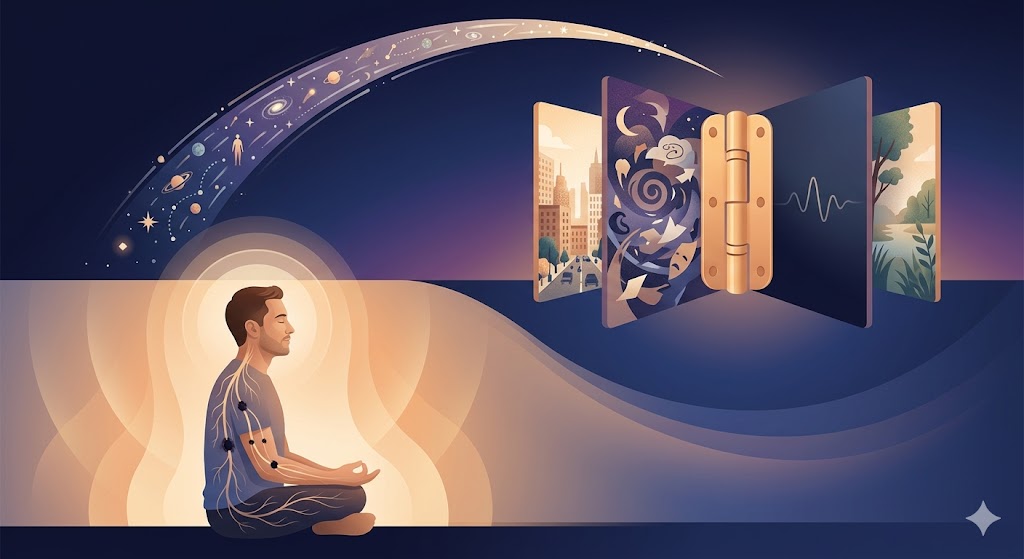
We stop being so disturbed by the changing conditions and impermanence of the relative world, because we’re anchored in the changeless reliability of the Absolute. To describe this relationship between changeless and changeable, the mystic Meister Eckhart employed the following analogy: “a door swings open and shuts on its hinges. I would compare the outer woodwork of the door to the outer man, and the hinge to the inner man. When the door opens and shuts, the boards move back and forth, but the hinge stays in the same place and is never moved thereby.”
In CC, our nervous systems are so clean and clear that our decisions are no longer based on past hurts and unhealthy dependencies. From here, we’re able to flow with life efficiently and effectively, doing less and achieving more, all the while operating from a spirit dominated by perpetual love and bliss.
Does any of this sound too good to be true? Hey, I get it. But the truth is that this is only the beginning of what’s possible with higher states of consciousness. And it isn’t hard at all to test the validity of these claims for yourself.
If you’re curious, I’d like to invite you to take a gander at TM.org to network with a TM teacher in your area, or just message me and I’ll be happy to connect you with more information and resources.
The eternity in me honors the eternity in you. Go now with love.
—Andrew
References
Alexander, C. N., & Boyer, R. W. (1989). Seven states of consciousness: Developing the full range of human potential through Maharishi’s Vedic Science and Technology. Modern Science and Vedic Science, 2(4), 342–344.
Maharishi Mahesh Yogi. (1970, August 8). Enlightenment: A state of life untouched by time and space [Video]. Maharishi Archives; Canvas@MIU. https://miuonline.instructure.com/courses/4628/pages/5-dot-3-video-enlightenment-a-state-of-life-untouched-by-time-and-space-maharishi
Maharishi Mahesh Yogi. (2026). Selected excerpts from Maharishi on higher states of consciousness (Part 2). In FOR 431: Higher States of Consciousness. Canvas. https://miuonline.instructure.com/courses/4628/pages/5-dot-7-readings-for-this-lesson
Pearson, C. (2013). The supreme awakening: Experiences of enlightenment throughout time—and how you can cultivate them (Excerpts). MUM Press. Retrieved from FOR 431: Higher States of Consciousness, Canvas. https://miuonline.instructure.com/courses/4628/pages/5-dot-7-readings-for-this-lesson
Travis F. (2014). Transcendental experiences during meditation practice. Annals of the New York Academy of Sciences, 1307, 1–8. https://doi.org/10.1111/nyas.12316
Travis, F. T. (2022). Your brain is a river, not a rock (Third Edition). CreateSpace Independent Publishing Platform. (Original work published 2012.)
[…] (This post is a continuation of On Transcendental and Cosmic Consciousness) […]
[…] and Maharishi’s teachings, you may enjoy my integrative essays (modified into blog posts): On Transcendental and Cosmic Consciousness and On God and Unity […]